Case study · Shoniz
360° Evaluation System
An employee evaluation panel, from one of my first projects
- Role
- UI/UX Designer (very junior at the time), working directly with the product owner
- Context
- Shoniz
- Tools
- HREnterpriseEarly work
01
Context
The problem
The 360° Evaluation System lets a company run evaluation rounds in which colleagues rate each other. HR prepares questions, relations between employees and evaluation models, starts a round, and follows its status. Each employee then sees an individual result.
What was broken
Evaluating people from several directions needs many moving parts: questions, who evaluates whom, models, rounds with start and end dates, comments, and results that stay fair and private. They had to fit into one clear panel that HR and employees could use without training.
02
Approach
How I got there
01
Field research and talks with the stakeholders to understand the real work, desk research on similar products and best practices, and business meetings to agree on the problem and find the solution. I did the full product-design scope: research, solution finding and design.
02
Worked directly with the product owner on the rounds, the roles and the results people should see.
03
Planned the flows for HR (managing questions, relations, models, evaluations and comments) and for employees (taking part and viewing results).
04
Designed the screens and refined them through prototypes, iterations and reviews with stakeholders.
03
Thinking
Key decisions
I decided to
Set up the system in four numbered steps on the home screen
Because
The admin home shows questions, employee relations, evaluation models and evaluations as cards numbered 1 to 4, in the order they have to be prepared.
I decided to
Show a person's own rating next to the group's
Because
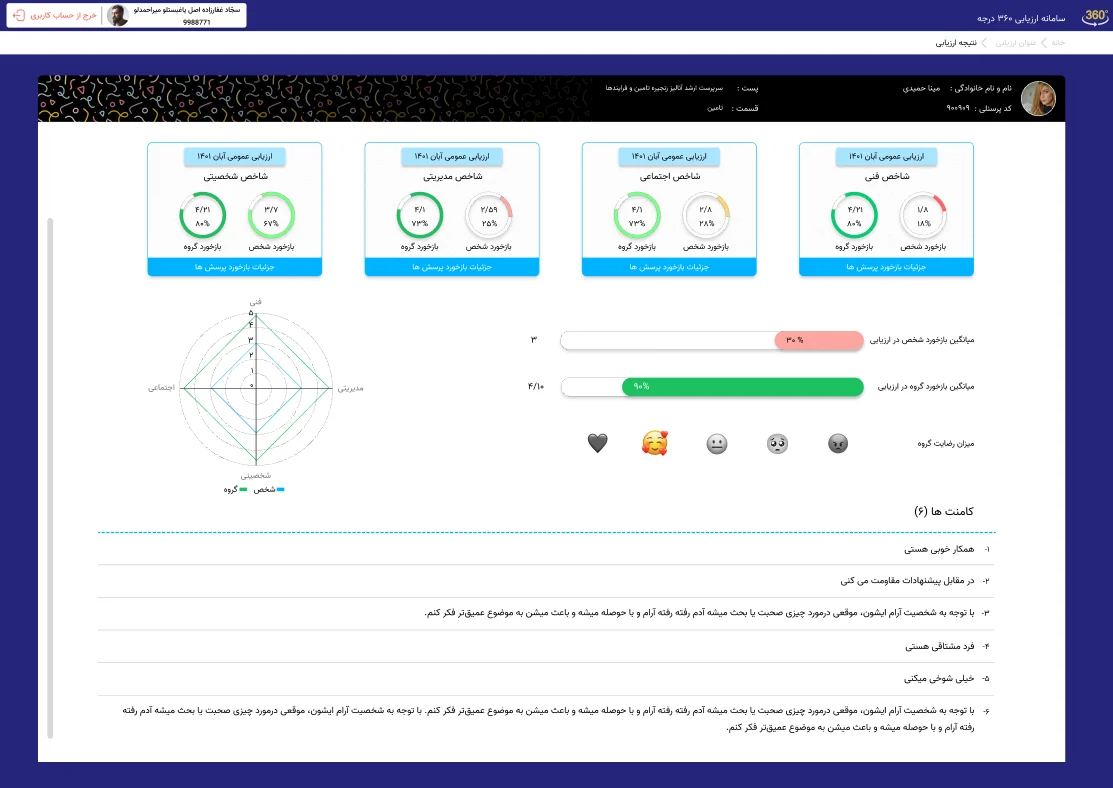
Every index (technical, social, managerial, personality) has two rings, one for self feedback and one for group feedback, and a radar chart compares the two shapes.
I decided to
Hide the result when too few people evaluated
Because
If the number of evaluators does not reach the minimum, the person sees an explanation instead of results, so comments and scores cannot be traced back to individuals.
04
Impact
Results
- One panel for preparing, running and reading 360-degree evaluations.
- A result page that compares self view and group view in one glance.
Why so few screens? Most of this work is under NDA, so I can only share a small part of it. I am happy to walk through the rest in a conversation.
The craft
Screens
What I took away
This is one of my earliest projects. I designed it when I was very junior, so I show it as it was and not as I would do it today. It taught me how to turn a complex HR process into steps, and how much privacy rules shape a result page.